

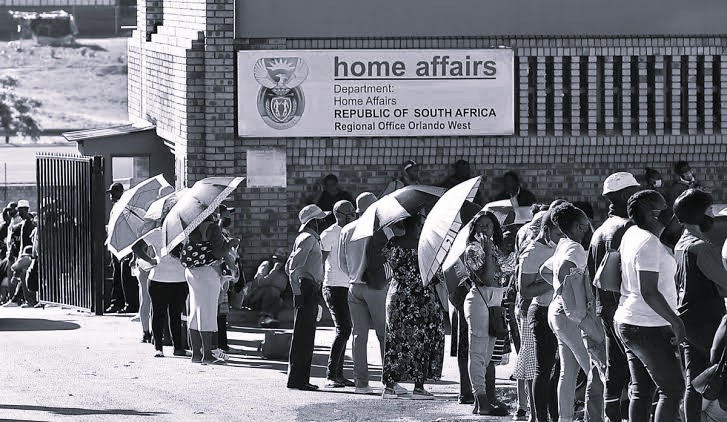
Stuck With “Temporary” Permit for Fifteen Years
There is a substantial community of Zimbabwean Exemption Permit (ZEP) holders in South Africa that has been living in a waiting room since 2009. Many of the ZEP holders are active participants of every community they live in, where some members teach in public schools, nurse in public hospitals, run spaza shops, pay PAYE and VAT, raise children who speak isiZulu or Sesotho before Shona or Ndebele, and still, after many years, they cannot apply for permanent residence within the country.
A recent article by Christine Hobden of the Wits School of Governance argues that the ZEP saga is usually read as a migration story when it is also a story about the quality of South Africa’s own governance. This is why the blog rewritten with inspiration from the article, looks at reframing the narrative that will move past the debate about open versus closed borders and start conversations towards something more concrete, e.g. how a state communicates, decides and keeps its word.
Two permits, two very different promises
The dispensation of Zimbabweans project began in 2009 as an emergency measure, and it has behaved like one. Home Affairs reduced the application fee and reduced the requirements for application documents and accepted applications from Zimbabweans who had lost their passports (Sintha Chiumia & Anim van Wyk, 2014).
Four years later, the mood had changed. New rules were made in 2014, which sparked panic among Zimbabwean expats, with some fearing for their jobs, others reading the manoeuvre as a way to push them out of the country. In August of the same year, Minister Malusi Gigaba announced the Zimbabwean Special Dispensation Permit and reassured people that nobody would have to travel back home to apply, and that the permit would expire at the end of 2017 (Sintha Chiumia & Anim van Wyk). A few years later, the same person is holding a very different piece of permit, which has a different name and its own design: “Zimbabwean Exemption Permit (ZEP) section 31(2)(b)”. Under the “conditions” section of the permit there are now four clauses: The permit still allows work, but it also says that the holder may not apply for permanent residence, no matter how long they have lived in South Africa. It says that the permit will not be renewed or extended (Although the government extends it from time to time). And it also says that the holder of the permit cannot change its terms from inside the country.
When looking at the two forms of documents side by side, you realise that the permit that once carried the normal conditions of a work visa now has “closing doors” as its main feature. Years of residence, which usually strengthened a person’s claim, are basically countless in this case.
The government’s case deserves a fair hearing
It would be simple to read this blog as a simple hostility towards Zimbabweans, and the record doesn’t support that way of reading or understanding. The original dispensation was by measure a generous act. In 2009, South Africa suspended deportations of Zimbabweans and open a visa free window and invited undocumented Zimbabweans to be regularise under calm requirements and approved roughly 242 000 applications (Human Rights Watch, 2009). Home Affairs also faced genuine administrative crisis. Between 2004 and 2008, its asylum system was overwhelmed by many applicants who the department believed were economic migrants who would never qualify for refugee status (UNHCR, 2006). The department’s legal case also holds together on its own terms: an exemption under section 31(2)(b) is something the minister may grant (RSA Gov, 2023), not something anyone is owed, and the conditions were printed on the permits themselves.
The department’s recent conduct also sits awkwardly with the idea that it is acting out of ill will. In the Helen Suzman Foundation vs the Minister of Home Affairs and Others (Case 32323/2022) (SAFLII, 2023), the high court set aside the 2021 decision to end the permits, finding the process as procedurally unfair under the Promotion of Administrative Justice Act (SAFLII, 2000). The court ordered the minister to take the decision again, this time through a fair and consultative process and directed that the permit remain valid for twelve months from the date of Judgement. The department has since then followed through with the court order. In April 2025 the current minister of home affairs set up and advisory Board, which falls under Section 4 of the Immigration Act, which allows the board to advise the minister on immigration policy, regulation and Implementation (DHA, 2025). The board had laid dormant for more than a decade and mong the tasks it was given is reviewing the exemption permits and report its findings to the minister. The courts deadline for a new decision was November 2025, and it passed without one. Instead, in October 2025 the department was granted an eighteen-month extension to May 2027, acknowledging that stakeholders would need to be consulted (Bernard Chiguvare, 2025).
The lesson here is not that South Africa owes the world open borders. The country may run a temporary permit scheme, and it may bring one to an end. That is a normal part of governing. But if run a scheme for fifteen years, some things need to be mentioned clearly, tell people clearly what the permit is, give them enough notice time to make plans and be honest that after fifteen years, the situation is no longer what it was at the start.
Link to the journal: https://sihma.org.za/storage/journals/5.%20The%20Democratic%20Costs%20of%20South%20Africa's%20Zimbabwean%20Exemption%20Permit%20Process.pdf
References
Bernard Chiguvare. (April 4 , 2025). mmigration Advisory Board appointed for the first time in a decade, says Schreiber. Mimupada lati GroundUp: https://groundup.org.za/article/immigration-advisory-board-appointed-for-the-first-time-in-a-decade-says-schreiber/
DHA. (2002). Immigration Act 13 of 2002. Mimupada lati Government: https://www.gov.za/sites/default/files/gcis_document/201409/a13-020.pdf
DHA. (Apr 01 , 2025). Minister Leon Schreiber appoints Immigration Advisory Board. Mimupada lati DHA: https://www.gov.za/news/media-statements/minister-leon-schreiber-appoints-immigration-advisory-board-01-apr-2025
Human Rights Watch. (April 30, 2009). South Africa: Stop Deporting Zimbabweans. Mimupada lati Human Rights Watch: https://www.hrw.org/news/2009/04/30/south-africa-stop-deporting-zimbabweans
RSA Gov. (Dec 18 , 2023). Home Affairs on requirements for applications for exemption permits to be issued in terms of section 31 (2) (b) of the Immigration Act 13 of 2002. Mimupada lati RSA Gov: https://www.gov.za/news/media-statements/home-affairs-requirements-applications-exemption-permits-be-issued-terms
SAFLII. (November 30 , 2000). Promotion of Administrative Justice Act 2000. Mimupada lati SAFLII: https://www.saflii.org/za/legis/consol_act/poaja2000396/
SAFLII. (June 28 , 2023). Helen Suzman Foundation and Another v Minister of Home Affairs and Others [2023] ZAGPPHC 490; 32323/2022. Mimupada lati SAFLII: https://www.saflii.org/za/cases/ZAGPPHC/2023/490.html
Sintha Chiumia & Anim van Wyk . (September 26 , 2014). FACTSHEET: The new special dispensation permit & what it means for Zimbabweans in SA. Mimupada lati Africa Check: https://africacheck.org/fact-checks/factsheets/factsheet-new-special-dispensation-permit-what-it-means-zimbabweans-sa
UNHCR. (July 6 , 2006). South Africa tackles its growing backlog in asylum applications. Mimupada lati UNHCR: https://www.unhcr.org/us/news/stories/south-africa-tackles-its-growing-backlog-asylum-applications
Categories:
Tags:
- Border Policy South Africa.
- Zimbabwean Special Dispensation Permit
- Spaza Shops And PAYE Tax Contributions
- South Africa Asylum System
- Regularisation Of Undocumented Migrants
- Administrative Fairness PAJA
- Open Versus Closed Borders Debate
- Migration Governance
- Zimbabwean Expats South Africa
- ZEP Extension 2027
- Malusi Gigaba Permit Changes
- Immigration Act Advisory Board
- PAFA Section 31(2)(b)
- Helen Suzman Foundation Vs Minister Of Home Affairs
- ZEP Court Ruling
- Permanent Residence Rights
- Temporary Residence Permits
- South African Immigration Policy
- Wits School Of Governance
- Christine Hobden
- Home Affairs South Africa
- ZEP Legal Saga
- ZEP South Africa
- Zimbabwean Exemption Permit