

Working Without a Safety Net: Migrants, Refugees and Asylum Seekers in South Africa
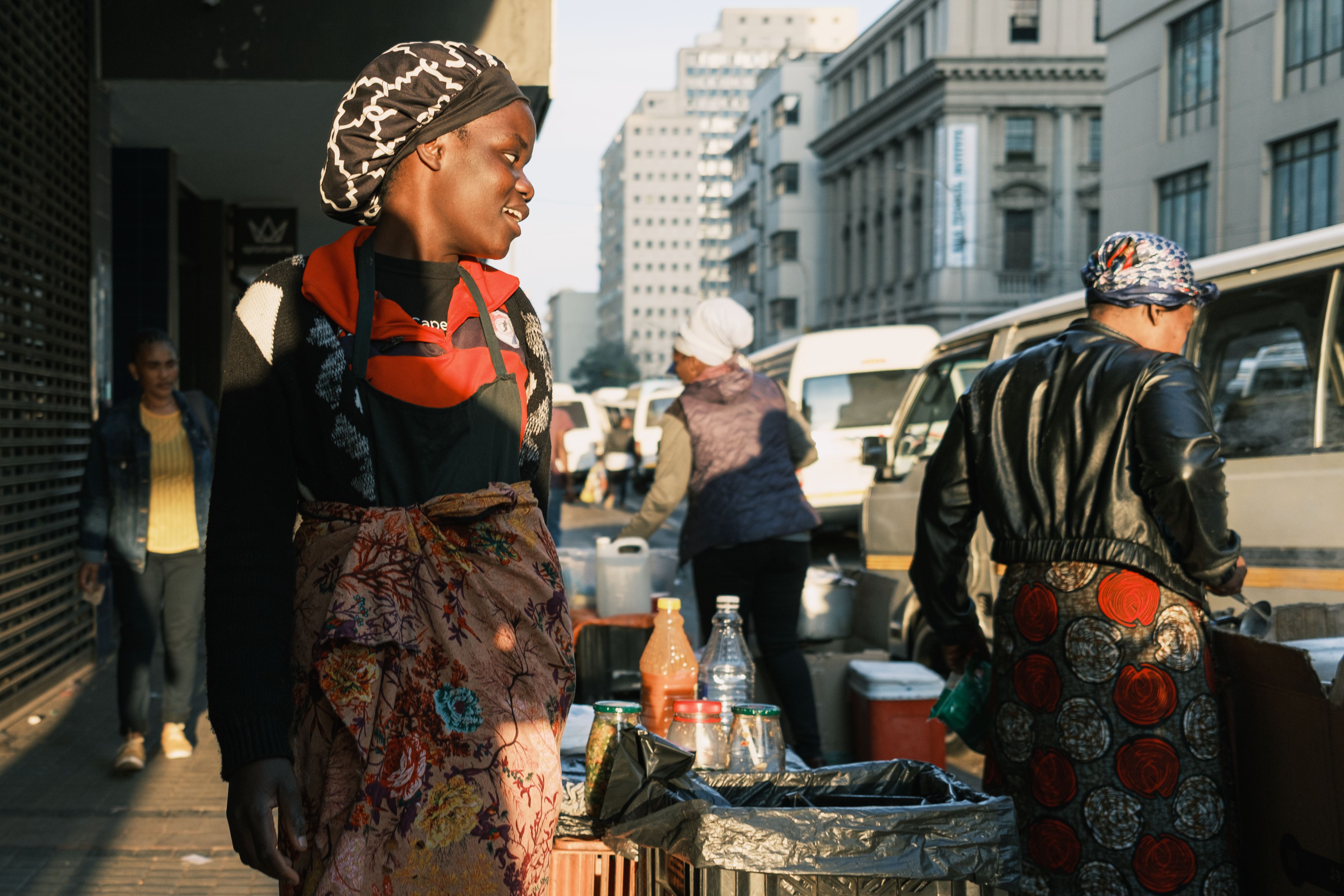
Behind South Africa’s migration debate are women who sell goods across the street, clean homes, serve at restaurants, and sell goods in small corner shops. Bezawork Ayele Kassa set out to understand their working lives. Using a mixed-methods approach, she collected quantitative data from 201 migrant women and qualitative data from 20 migrant women, and she held 5 key informant interviews in Cape Town and Johannesburg. Just over half of the survey respondents were refugees or asylum seekers; the rest were visa holders, permanent residents or undocumented migrants. Kassa’s main finding is that “most of these women work, but fewer are well protected.”
Work found through people, not policy
According to the author’s, 82.6% of respondents (166 of 201) were working and employment rates were similar across legal statuses, from 80.8% among permanent residents to 86.7% among undocumented women (Bezawork Ayele Kassa, 2026, p. 89). What differed was job quality of those employed, with 40.4% working informally on their own and 28.9% working without contracts, so roughly seven in ten people had no formal employment arrangements (Bezawork Ayele Kassa, 2026, p. 91). The author notes that informality may either signal either economic instability or a thriving informal economy, but warns that working without contracts leaves migrants open to wage theft, long hours and sudde dismissal (Bezawork Ayele Kassa, 2026, pp. 89-90).
The author found that 62% of working respondents were assisted by fellow migrants to find employment, 18.1% found employment through private agencies, 8.4% found employment through websites, 6% found employment by their own efforts and 5% found employment through national employment agencies. Kassa also argues that formal channels demand documents, credentials or fees that migrants struggle to meet, so friends and co-nationals become the real employment service (Bezawork Ayele Kassa, 2026, p. 92).
Interestingly as well, It was found that 68.1% of respondents had no workplace leave and 74.1% had no medical insurance, which is a figure that aligns with literature showing that migrant workers are often excluded from formal labor protections and benefits due to precarious employment, informal contracts, or discriminatory workplace practices (Crush, Tawodzera, Salamone, & Ahmed, 2025).
The state's view: strong laws and hard trade-offs
The author notes that the constitution guarantees equality and the National Labour Migration Policy recognises migrants worker’s vulnerability and promises equal treatment, although implementation gaps persist. A Department of Employment and Labour Official told the author that inspectors routinely find migrant women denied leave, paid below minimum wage and domestic worker standards and left unregistered for employment insurance and injury compensation (Bezawork Ayele Kassa, 2026, p. 92). The author also interviewed a Cape Town employer who mentioned that labour inspectors often treat businesses like trafficking rings, despite employers lacking access to Home Affairs biometric tools to verify documentation. The employer added that regarding fake documentations, a lot of desparate women sometimes resort to using fraudulent identity or asylum documents to secure employment (Bezawork Ayele Kassa, 2026, p. 97).
In June 2026, the Employment Service Bill was introduced to Parliament, requiring employers to show that no suitable qualified citizens, permanent residents, refugees or asylum seekers are available before hiring foreign workers, with fines of up to R100 000 for a first offence (Minister of employment and labour, 2026). The president of south africa also argues that this bill stands to protect everyone and that some employers hire undocumented migrants precisely because their status makes complaints difficult (The Presidency of Republic of South Africa, 2026).
The study shows that migrant women work and contribute a lot more to both their families and the South African economy, yet they find themselves marginalised within its labour market. What they lack is not effort but security within their workplaces, ranging from basic worker rights such as paid leave, a written contract, the minimum wage, and registration for unemployment insurance and injury compensation. The government’s concerns about jobs, documentation and fair competition are real, and so are the exploitations that the author and various officials describe. The best possible solution for everyone involved is to have clear, enforced rules that employers, regulators and migrants can understand and trust.
References
Bezawork Ayele Kassa. (August 31, 2026). Migrant Women in the Labor Force in South Africa: A Mixed-Methods Analysis. Mimupada lati SIHMA: https://sihma.org.za/storage/journals/4.%20Migrant%20Women%20in%20the%20Labor%20Force%20in%20South%20Africa.pdf
Crush, J., Tawodzera, G., Salamone, M., & Ahmed, Z. (January 10, 2025). Pandemic mobilities,livelihood disruptions, and food insecurities among Eastern Cape migrants in Cape Town and Johannesburg during COVID-19. African Human Mobility Review. Mimupada lati SCIELO: https://scielo.org.za/pdf/ahmr/v10n3/05.pdf
Minister of employment and labour. (may 29, 2026). Employment service bill. Mimupada lati https://www.parliament.gov.za/storage/app/media/Bills/2026/B16-2026_Employment_Services.pdf
The Presidency of Republic of South Africa. (June 7 , 2026). Address by President Cyril Ramaphosa on migration, Union Buildings. Mimupada lati The presidency of Republic of South Africa: https://www.thepresidency.gov.za/address-president-cyril-ramaphosa-migration-union-buildings-tshwane
Categories:
Tags:
- Labor Law Enforcement.
- South African Economy
- Job Search
- Social Networks
- Domestic Workers
- Minimum Wage
- National Labour Migration Policy
- Employment Service Bill
- Workplace Exploitation
- Labor Rights
- Precarious Work
- Undocumented Migrants
- Asylum Seekers
- Refugee Employment
- Johannesburg
- Cape Town
- Bezawork Ayele Kassa
- Informal Economy
- Migrant Women Workers
- South Africa Migration