

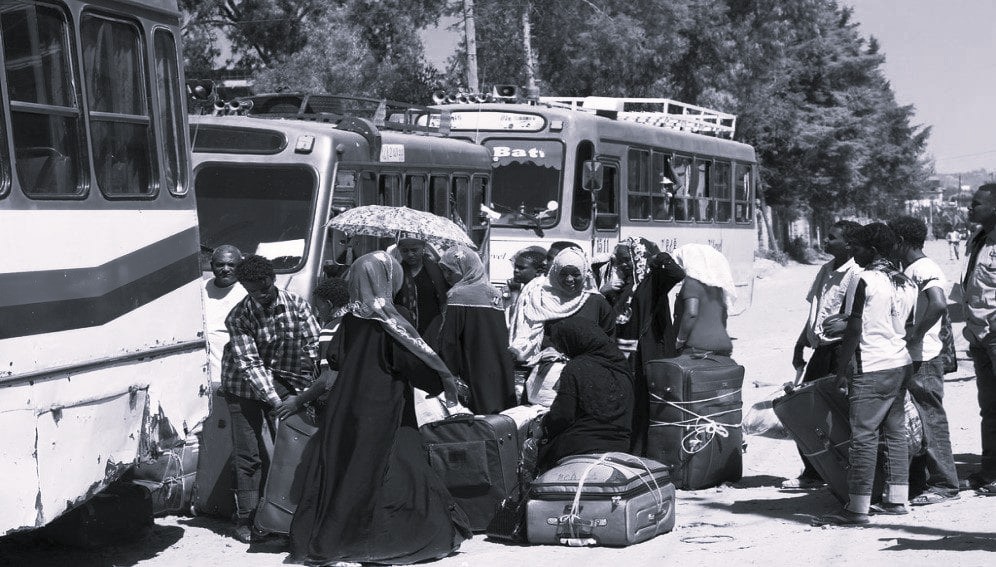
Two Sides of One City: Rural Youth, Urban Migration, and the Search for Balance
Every year, a large number of people leave their home to pursue better opportunities. While many cross international borders, others prefer to move within their own country, from a struggling village to a growing city. Although the nature of the journeys varies, they all pose the same question: how do young migrants and the cities that receive them find their footing together? A recent study of Hawassa, one of Ethiopia’s fastest-growing cities, offers a grounded look at this question from both sides.
The study, published by Girma Chuluke, Tesfaye Semela, Tafesse Matewos, Tesfaye Ashine, and Daniel Semela in the African Human Mobility Review, focuses on internal migrants mostly children, teenagers and young adults moving from Sidima’s rural district to Hawassa. Even so, the picture it paints of arrival, adjustment and strained capacity speaks to issues that extend far beyond Ethiopia, and it offers useful lessons for anyone thinking about how migrant and host communities can move forward together.
Why people leave
Drawing on a survey of 408 migrant households and interviews with ten young migrants and ten local officials, the study finds that migration decisions rarely come down to one factor alone. Land scarcity, limited employment, and the pull of relatives already settled in the city were the strongest predictors: households with a relative in Hawassa were around fifteen times more likely to migrate, and those seeking work were roughly five times more likely to leave than those who weren’t. The interviews add texture to the statistics.
Many respondents pointed to a parent’s death or illness, family breakdown, or simply a sense that the village offered no realistic way forward as what finally pushed them to move. One thirteen-year-old described coming to Hawassa with friends after his father remarried and left the family; his mother who was in poor health, could no longer send him to school or keep the household fed. Another twelve-year-old left after his father died and the farmland was divided among relatives, leaving too little for anyone to live on. For many young people, migration is not an ambition but the most workable option left.
Arrival seen from both sides
Life in Hawassa is uneven for the newly arrived. Around four in five are engaged in some form of paid work, mostly informal, yet fewer than half say they can reliably support their families.
Those who arrive with a relative or an existing network tend to settle in more steadily. Tefera, a seventeen-year-old from Aleta Chuko whose parents cover his college fees and housing, described a fairly smooth transition: steady income from a small business and a clear sense of progress. Migrants who arrive alone, particularly unaccompanied children, face a harder path. One twelve-year-old described older boys on the street routinely taking money from younger children by force, and how some children have turned to sniffing benzene from plastic bottles, a practice several respondents linked less to recklessness more to a grim practical logic of using it to dull the hunger they cannot afford to satisfy.
City officials interviewed for the study describe the same period from their own vantage point, and their account is one of genuine strain rather than indifference. One administrator put it plainly: public infrastructure, housing, electricity, and water were already stretched too thin for existing residents, before factoring in a steady influx of newcomers who often arrive without the vocational preparation the local job market expects. Officials in Hawassa’s most migrant-dense sub-cities, Menaheria and Tabor, were candid that structured health-care support for young migrants is essentially absent, not because no one cares, but because the systems for delivering it were never built at this scale. Several also pointed to modest, locally organised responses already underway, such as skills-training programmes in woodworking, sewing, and metalwork run in partnership with local NGOs, a start though officials themselves describe these efforts as small relative to the need.
When considered as a whole, these two stories do not identify a single villain; instead, they depict a city that is growing quicker than its services can, as well as a constant stream of newcomers who frequently have little to rely on but hope and familial ties. In a sense, both migrants and the administrators attempting to assist them are dealing with greater demand than the system was designed to accommodate.
Staying, Leaving or Moving On
One of the more outstanding findings is how unsettled the question of "home" remains even after migration. Hawassa was not their ultimate destination, according to more than half of the households surveyed. The vast majority of participants who planned to migrate were searching for a different Ethiopian city or town, while slightly more people wanted to leave the country entirely. This serves as a signal that internal and international migration are sometimes not distinct journeys but rather different phases of the same one.
The researchers also associate this pattern to the multifaceted stressors, such as gender-based abuse at home, that frequently influenced women's first decision to leave. Women were far more likely than males to be thinking about moving further. A small percentage of participants stated that if things in the city did not get better, they hoped to go back to their villages. Elias, a thirty-two-year-old Shebedino resident, put it simply: if things continue to be difficult, he and his family would return to the countryside because, at least, they could eat whatever the farm produced, whereas in the city, hunger often went unmet. His statement serves as a helpful counterbalance to any narrative that views moving to the city as an automatic upgrade: for many households, rural living still provides a level of food security that urban informal employment does not.
Categories:
Tags:
- Migration Policy Lessons
- Socioeconomic Mobility
- Development Studies
- African Urbanization
- Urban Adjustment Challenges
- Migration Push Factors
- Family Networks Migration
- Rural Food Security
- Female Migration Drivers
- Ethiopian Migration Patterns
- Secondary Migration
- NGO Skills Training
- Hawassa Tabor
- Hawassa Menaheria
- Public Infrastructure Strain
- Street Children
- Urban Poverty
- Informal Employment
- Rapid City Growth
- Urbanisation Challenges
- Migrant Household Survey
- Child Migrants
- Youth Migration
- Sidama Region
- Rural To Urban Migration
- Tesfaye Semela
- Girma Chuluke
- African Human Mobility Review
- Hawassa City Study
- Ethiopia Internal Migration