

Trapped Between Borders: The Hidden Crisis Facing Migrants and Refugees in Libya
Since 2011, Libya has gone from being one of the best destinations for labour migration to now being one of the most dangerous places in the world for the same people who worked to build its economy. Before the revolution, Libya hosted about 1.35 to 2.5 million migrant workers (Borgnäs Emma; Cottone L.; Teppert Tassilo, 2020), who were drawn by competitive wages and steady demand for labour in construction, healthcare, agriculture and manufacturing. Today, Libya has become a place where migrants are likely to face detention, exploitation and violence as they try to find work.
Nearly 800,000 people left in 2011 when violence first erupted, yet Libya still attracted hundreds of thousands of migrants in the following years, with an estimated 625,000 migrants by 2020, with most migrants coming from sub-Saharan and North African countries (Borgnäs Emma; Cottone L.; Teppert Tassilo, 2020). Libya is also a major transit country, but for many people it is not the intended destination but a stop on the way to europe. Since libya’s coastline lies a short sea crossing from italy, those who cannot afford the crossing or intercepted trying to make it, often end up stranded there.
The Reality for Migrants and Refugees
Under legislation dating back to 1987 (UNHCR, 1989) and reinforced in 2010 ( National Legislative Bodies, 2010), any form of irregular entry, stay or exit is treated as a criminal act, regardless of whether the person is an economic migrant, a trafficking victim or someone fleeing from war (UNHCR, 1989). This may seem at odds with libya’s history as a destination for labour migrants, but the two co-existed for years. While the country relied on foreign workers, the law was applied unevenly and migrant labour was largely tolerated. Since 2011, the collapse of the central authority and the rise of rival armed groups have removed that discretion. The same laws now operate alongside a detention system in which a lot of people are held captive in detention centres while others are being held captive by armed groups, so people without papers are exposed whether they are in the country ligally or illigally.
The penalty is a fine of 1000 Libyan dinars or up to three years in prison, followed by deportation. In practice, this means that migrants are rarely given the opportunity to stand for a trial, instead they are held indefinitely with no clear path to getting released (UNSMIL & OHCHR, 2018 ). Libya has never signed the 1951 Refugee Convention and has no functioning asylum System (UNHCR, 1951 ), so even people with a legitimate claim to protection have nowhere to turn.
The journey to the region itself is often brutal for many people. Some migrants travel in organised groups with many having already paid thousands of dollars to smugglers, while others move stages, a pattern known as step-wise migration, working informally between each stop to afford the next smuggler. Both paths expose people to unsafe transport, extortion, robbery, forced labour and violence. Women and girls usually face a particularly severe reality, mainly trafficking for sexual exploitation (Creta Sara, 2020), which has risen over the past decade, especially targeting women from neighbouring countries. Many of whom arrive in Europe pregnant after being raped in Libya, with many survivors describing being trapped in vague, ever-growing debts to their traffickers, enforced through threats against family back home. One woman told Human Rights Watch that “The suffering was so severe, she would not wish the journey on her worst enemy” (Human Rights Watch, 2019).
Children also bear a disproportionate share of the burden. Internal displacement in Libya has more than doubled between 2018 and 2020, and children aged 6 to 7 are now the fastest growing segment of the displaced (Gluck Caroline & Alalem Mohamed, 2020). Many migrants and refugee children have been identified as having an urgent need for help, and the overwhelming majority interviewed after reaching Italy reported having been held in captivity in Libya (UNSMIL & OHCHR, 2018 ).Many try to survive by staying invisible, minimising time outside their homes, a coping strategy that only deepens their isolation from support.
Government Perspectives
Libya’s government frames its approach through a security and sovereignty lens. Migration is managed across several state bodies, which include the Ministry of the Interior General Administration for Coastal Security, a dedicated Directorate for Combating Illegal Migration, the Ministry of Defence’s Libyan Navy and Coastal Guards and the Ministry of Coastal Affairs. From the state’s perspective, the 2010 Law on Combating illegal Migration ( National Legislative Bodies, 2010) and its 1987 predecessor exist to protect national security and avoid smuggling networks, imposing harsher punishments in the name of border control. In 2018, Libya formally declared its own search and rescue zone off its western coast, asserting the authority to intercept and return migrant boats itself rather than leaving that role to Italy ( Bathke Benjamin , 2019), a move the Libyan state has presented as an exercise of sovereignty over its own waters, even as it has locked tens of thousands of people back into detention.
European governments, particularly Italy, have their own stated rationale, inseparable from Libya's. For two decades, EU institutions have pursued policies aimed at limiting arrivals on European shores, framing this as a matter of national security and orderly migration management. The 2008 Italy-Libya "Friendship Treaty" explicitly linked cooperation on migration to a broader fight against "terrorism, organised crime, drug trafficking and illegal immigration," and came with a commitment from Italy to pay $5 billion over 20 years toward Libyan border control, infrastructure, and social services (Ronzitti Natalino,2008). The 2016 Memorandum of Understanding deepened this, with Europe supplying speedboats, training coast guard personnel, and deploying its own staff to coordinate maritime operations, all justified publicly as necessary to prevent loss of life at sea and disrupt smuggling networks (UNHCR, 2019).
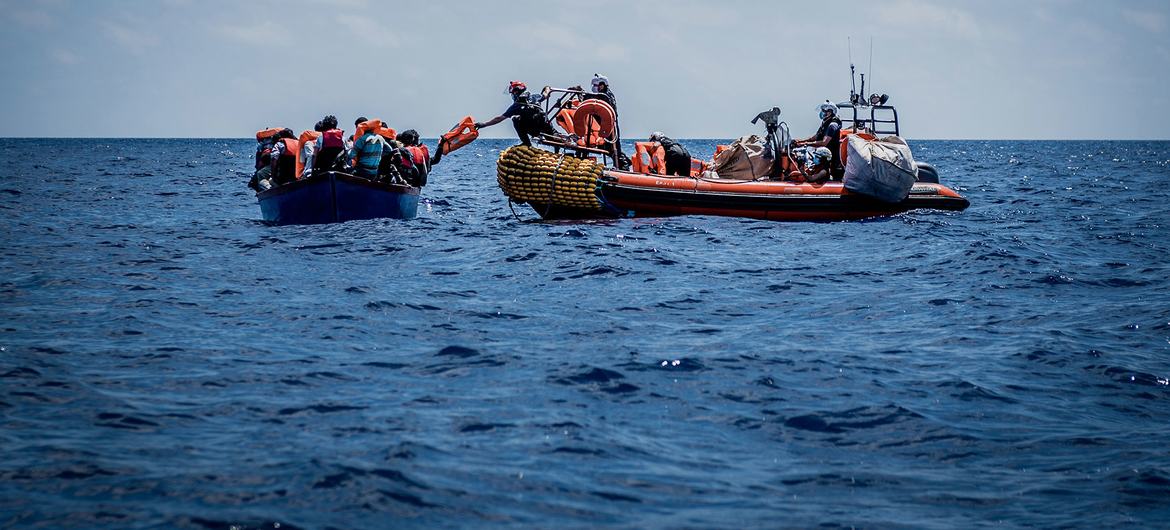
In practice, this cooperation has meant nearly half of migrants attempting the crossing to Europe are intercepted and returned to Libyan detention rather than reaching safety (Amnesty International, 2020), with close to 60,000 people sent back between 2016 and 2020 alone, even as the death rate at sea doubled over the same period. This cooperation is best understood as the externalisation of European migration control; rather than managing arrivals at its own borders, Europe has moved the work of stopping migration onto a transit country by funding, equipting and training Libyan forces to intercept people before they reach European waters (Amnesty International, 2020). Libya’s position as a transit country is what makes the arrangement possible and it means that many people who never intended to stay in libya are held there on Europe’s behalf. Both governments describe their policies as security and stability measures. For the people caught in between, those same policies translate into indefinite detention, exploitation, and a cycle very few manage to escape.
References
Bathke Benjamin . (July 24 , 2019). When helping hurts – Libya's controversial coast guard, Europe’s go-to partner to stem migration. Mimupada lati Info Migrants: https://www.infomigrants.net/en/post/18196/when-helping-hurts--libyas-controversial-coast-guard-europes-goto-partner-to-stem-migration
National Legislative Bodies. (January 1 , 2010). Libya: Law No. (19) of 2010 on Combatting Illegal Immigration. Mimupada lati UNHCR: https://www.refworld.org/legal/legislation/natlegbod/2010/147117
Amnesty International. (2020). ‘BETWEEN LIFE AND DEATH’: REFUGEES AND MIGRANTS TRAPPED IN LIBYA’S CYCLE OF ABUSE. Mimupada lati Amnesty International: https://d21zrvtkxtd6ae.cloudfront.net/public/uploads/2020/09/Libya-report-Between-life-and-death.pdf
Borgnäs Emma; Cottone L.; Teppert Tassilo. (2020). Labour migration dynamics in Libya. Mimupada lati Sematic Scholar: https://www.semanticscholar.org/paper/Labour-migration-dynamics-in-Libya-Borgn%C3%A4s-Cottone/00c9ad600d9cf5a1c08c5ddb281f5019da9d3246
Creta Sara. (06 21, 2020). Abused in Libya and forced into prostitution back home: the nightmare of trying to reach Europe. Mimupada lati euroNews: https://www.euronews.com/2020/06/21/abused-in-libya-and-forced-into-prostitution-back-home-the-nightmare-of-trying-to-reach-eu
Gluck Caroline & Alalem Mohamed . (January 28 , 2020). The challenge of helping child refugees in Libya overcome trauma. Mimupada lati UNHCR: https://www.unhcr.org/news/stories/challenge-helping-child-refugees-libya-overcome-trauma
Human Right Watch. (August 27, 2019). “You Pray for Death”: Trafficking of Women and Girls in Nigeria. Mimupada lati Human Right Watch: https://www.hrw.org/report/2019/08/27/you-pray-death/trafficking-women-and-girls-nigeria
Ronzitti Natalino . (2008). The Treaty on Friendship, Partnership and Cooperation between Italy and Libya: New Prospects for Cooperation in the Mediterranean? Mimupada lati University of Glasgow: https://www.gla.ac.uk/media/Media_126121_smxx.pdf
UNHCR. (1951 ). Libya. Mimupada lati UNHCR: https://rimap.unhcr.org/countries/libya
UNHCR. (January 31 , 1989). Libya: General People’s Committee Decree No. (247) of 1989 on the executive regulation of Law No. (6) of 1987 on organising the entry, residence, and exit of foreigners in Libya. Mimupada lati UNHCR: https://www.refworld.org/legal/decreees/natlegbod/1989/147188
UNHCR. (June 2019). Mixed Migration Routes and Dynamics in Libya in 2018. Mimupada lati ReliefWeb: https://reliefweb.int/sites/reliefweb.int/files/resources/impact_lby_report_mixed_migration_routes_and_dynamics_in_2018_june_2019.pdf
UNSMIL & OHCHR. (December 18 , 2018 ). Desperate and dangerous: Report on the human rights situation of migrants and refugees in Libya. Mimupada lati UNSMIL : https://unsmil.unmissions.org/sites/default/files/libya-migration-report-18dec2018.pdf
Categories:
Tags:
- Migration Crisis North Africa
- Border Control Sovereignty Libya
- Step-wise Migration
- Sexual Exploitation Trafficking
- Child Refugees Libya
- Forced Labour Libya
- Transit Migration Europe
- Human Rights Abuses Migrants
- Libyan Coast Guard Interceptions
- Directorate For Combating Illegal Migration
- Italy Libya Friendship Treaty
- European Migration Externalization
- Migrant Trafficking And Abuse
- Indefinite Detention Libya
- Irregular Migration Laws
- Mediterranean Sea Crossing
- Libya Refugees
- Migrant Worker Exploitation
- Labour Migration Libya
- Libya Migration Crisis