
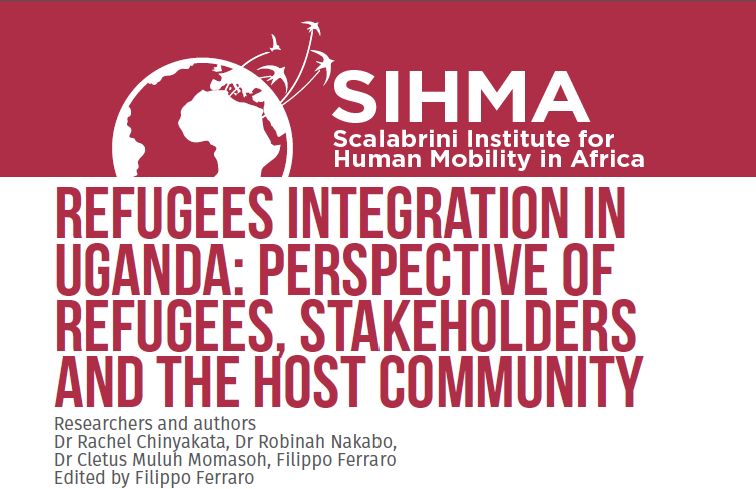
Research Launch: Refugees Integration in Uganda: Perspectives of Refugees, Stakeholders and the Host Community
On 12 May 2026, SIHMA launched the research “Refugees Integration in Uganda: Perspectives of Refugees, Stakeholders and the Host Community,” a journey that started in 2023 following the opening of a new mission by the Missionaries of St Charles Scalabrini in Uganda. The research aimed at informing the work of the Missionaries of St Charles and other projects that are aimed at enhancing refugee integration in Uganda. Given that Uganda hosts millions of refugees and asylum seekers and is the largest host in Africa, their integration and protection needs to be continuously prioritised and acknowledged as an important part of ensuring their well-being, belonging, peaceful coexistence and durable solutions. During the event, the SIHMA team led by Fr Filippo gave a background of the work of the Missionaries of St Charles around the world and in Uganda specifically focusing on the vision of serving people on the move. The SIHMA researchers briefly discussed the research aims and processes including the fieldwork that was conducted in Adjumani (Pagirinya and Nyumanzi) and Kampala, from end 2024 and early 2025 and a stakeholder verification workshop that was conducted in Kampala in July 2025 ensuring that the findings are grounded in the perspectives of the participants.
The event was attended by individuals and organisational representatives from the different organisations and regions in Uganda. The audience was diverse with representation from government, academia, host community, refugee population and organisations that work in the protection space and in supporting migrants and refugees. The event gave an overview of the recently completed and published research report and summarised the findings from the fieldwork and engagements with the different stakeholders, refugees and the host community as key informants of the research. Through the presentation a clear contrast between Kampala and the Adjumani contexts was given with Kampala being seen as a place of opportunity, offering greater possibilities for employment, economic advancement and independence from donor assistance although it had its own challenges. On the other hand, the settlements were noted as providing important support, mixed with hardship and limited opportunities for refugees to achieve self-reliance. The discussion also expounded on the needs and challenges of refugees that continue to affect everyday life in both contexts. The attendees of the online event further emphasised on the worsening of the situation of refugees in the country due to the reduction in humanitarian assistance and limited economic opportunities.
The event further elaborated on of the existing support initiatives for refugees as pointed out by the research which confirmed the narrative that Uganda offers a welcoming environment to refugees. One of the most important outcomes of the research is a proposed Key Performance Indicator (KPI) framework for refugee integration that was developed based on the information from the secondary sources and key informant interviews and workshop with refugees, host community members and different stakeholders. The framework provides a way stakeholders, organisations and service providers to move from broad commitments to measurable progress to ensure the effective integration of refugees in Uganda. The framework includes indicators on: Legal protection and civic involvement; Education and inclusion; Livelihoods, employment and income; Land and housing; Health and well-being; and Social cohesion, peace and security.
The online launch recommended the need stronger monitoring and enforcement of refugee protection laws, advocacy for refugee rights and expanded access to skills development, livelihoods, financial resources and empowerment programmes as key facilitators for integration. The SIHMA team also encouraged the need for institutionalising the KPI framework so that integration programmes can be consistently designed, implemented and monitored. Further research across other refugee-hosting regions was also recommended for comprehensive understanding and the development of the strategies aimed at ensuring the integration of refugees in Uganda.
The central message during the discussion by the stakeholders participating in the launch was that integration is not a one size fits approach, and therefore the context and the uniqueness of different individuals has to be taken into consideration. Furthermore, the discussion emphasised that refugee integration should move beyond humanitarian assistance toward sustainable inclusion and self-reliance. The event also brought to light and strengthened the need for multi-stakeholder coordination and collaboration in facilitating the integration of refugees. The research launch marks an important step in that journey bringing evidence, experiences and practical tools together to help facilitate the integration of refugees in Uganda.
Link to the Paper: https://sihma.org.za/reports/refugees-integration-in-uganda-perspective-of-refugees-stakeholders-and-the-host-community-1?lang=en
Categories:
Tags:
- Forced Migration Research.
- Host Community Relations
- Social Integration Africa
- Refugee Rights Advocacy
- Humanitarian Assistance Cuts
- Refugee Self-reliance
- Sustainable Inclusion
- Multi-stakeholder Coordination
- Social Cohesion And Peace
- Health And Well-being
- Land And Housing
- Livelihoods And Employment
- Refugee Education And Inclusion
- Legal Protection And Civic Involvement
- KPI Framework Refugee Integration
- Key Performance Indicator Framework
- Kampala Refugees
- Nyumanzi
- Pagirinya
- Adjumani Settlement
- Durable Solutions
- Refugee Protection
- Missionaries Of St Charles Scalabrini
- SIHMA Research
- Refugee Integration In Uganda