

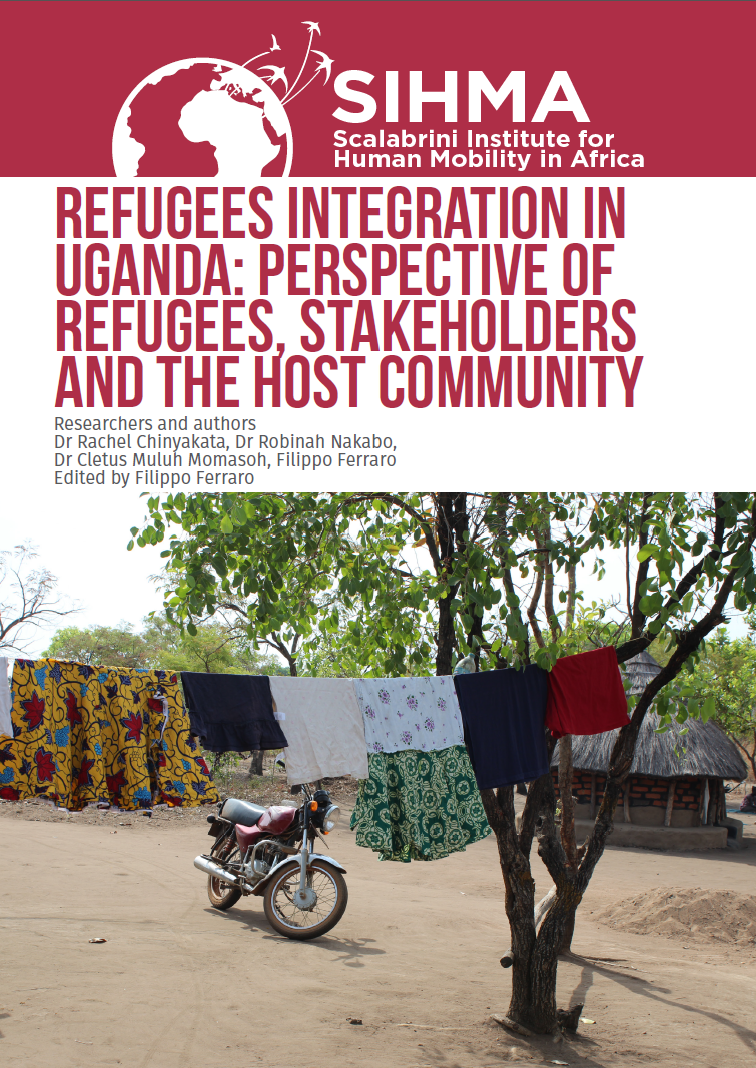
Refugees integration in Uganda: Perspective of Refugees, stakeholders and the Host community
Published by: Published by: SIHMA
Based on the need to strengthen responses and programmes to support refugee integration in Uganda and beyond, the Scalabrini Institute for Human Mobility in Africa, the missionaries of St Charles Scalabrini Uganda, and other partners conducted this research. The research report explores the integration of refugees in Uganda, particularly focusing on how integration is perceived, as well as the barriers and facilitators to integration. Focus is also given to understanding refugee needs, available support services, and gaps in support as essential factors shaping integration. Lastly, the report proposes a list of indicators that could be used to monitor the integration of refugees.
The report is based on fieldwork conducted in Uganda, specifically in Kampala, representing the urban context, and Adjumani, representing the settlements, from December 2024 to February 2025. Participants included stakeholders working with refugees, refugees themselves, and some members of the host community (HC) in Kampala and Adjumani. The study was conducted in these two districts to provide an understanding of refugee integration in both the urban context and the settlements.
The findings in this report reflect that Uganda is an environment consisting of both support and opportunities, mixed with difficulties and barriers that affect refugees’ ability to integrate into the social and economic fabric of society. Although the policy environment is described as progressive, there was a disjuncture between policy and implementation, mainly attributed to resource shortages, discrimination, lack of will from departments and stakeholders involved, and other systemic issues that interplayed in blocking the integration of refugees. Coupled with other individual barriers such as language, limited skills and education, and economic status, the report highlights some of the practical challenges resulting from the above-mentioned barriers, including limiting refugees’ sense of agency and future aspirations.
This report also shows the realities of the lives of refugees within and outside the settlements, with both areas presenting their own opportunities and challenges. The report identifies and proposes some key performance indicators that could be used to monitor and shape implementation in Uganda. Through this research, we provide recommendations to inform advocacy, research, and initiatives aimed at enhancing, supporting, and facilitating the integration of refugees in Uganda.
Refugees integration in Uganda: Perspective of Refugees, stakeholders and the Host community
Categories:
Tags:
- Refugee Support Systems
- Migration And Development
- Refugee Communities
- Integration Research
- Refugee Opportunities
- Refugee Challenges
- Refugee Integration Monitoring
- Social Policy
- Refugee Assistance
- Humanitarian Initiatives
- Sustainable Integration
- Refugee Welfare
- East Africa
- Refugee Research
- St Charles Scalabrini Uganda
- Scalabrini Institute For Human Mobility In Africa
- Integration Indicators
- Refugee Programmes
- Development Studies
- Refugee Rights
- Refugee Employment
- Refugee Education
- Social Cohesion
- Refugee Resilience
- Humanitarian Response
- Migration Policy
- Refugee Empowerment
- Community Development
- Refugee Protection
- Refugee Advocacy
- Systemic Challenges
- Policy Implementation
- Refugee Needs
- Integration Facilitators
- Integration Barriers
- Refugee Inclusion
- Refugee Livelihoods
- Displacement
- Humanitarian Research
- Refugee Support Services
- Economic Integration
- Social Integration
- Migration Studies
- Refugee Policy
- Host Communities
- Urban Refugees
- Refugee Settlements
- Adjumani
- Kampala
- Uganda
- Refugee Integration